

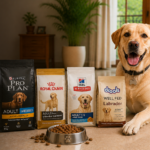



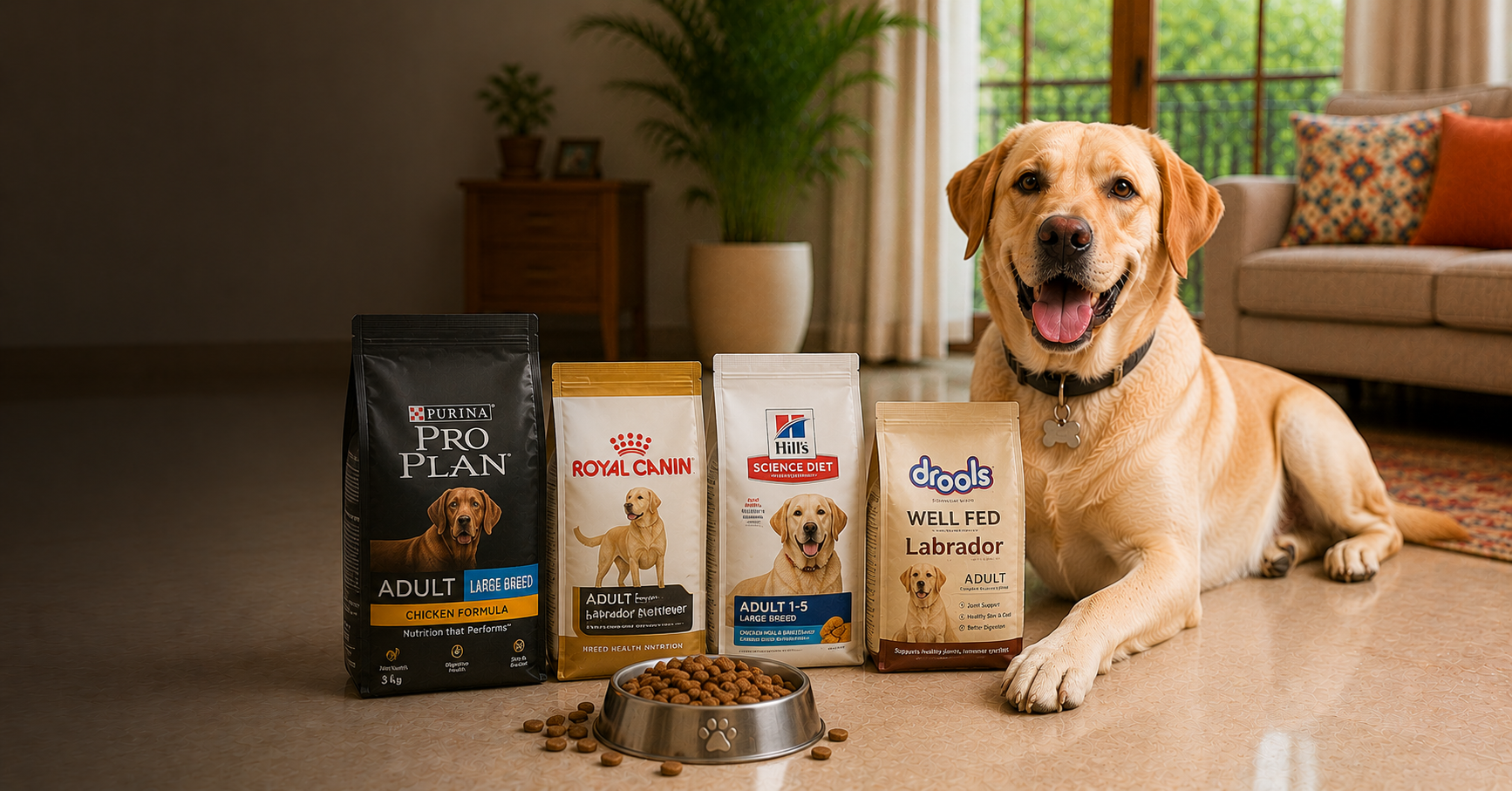

Choosing food for a Labrador can feel harder than it should. Bags make similar promises, prices change constantly, and a hungry Lab will happily suggest that every portion is too small.
There is no single food that is best for every Labrador. A suitable choice depends on your dog’s age, body condition, activity, health, and tolerance of the exact recipe. This guide compares four adult dry foods currently relevant to Indian buyers. It does not rank them from universal winner to loser or call them “vet approved.”
Quick answer
- Royal Canin Labrador Retriever Adult is the most breed-specific option. Its 13% fat level and specially shaped kibble may suit owners who want a measured adult formula designed around Labrador eating habits.
- Hill’s Science Diet Adult Large Breed Chicken & Barley Recipe is a mainstream large-breed formula with a clearly defined age and size use. Do not confuse it with Hill’s prescription diets or assume it will treat digestive disease.
- Farmina N&D Ancestral Grain Chicken & Pomegranate Adult Medium & Maxi has 30% protein and 18% fat. It may suit a healthy, active adult that tolerates a richer, more energy-dense recipe, but portions deserve close attention.
- Purina Pro Plan Adult Large Breed is a practical general large-breed option sold through Purina India. Its Indian product page lists 26% protein and 12% fat, making it easy to compare with the other formulas.
Availability and recipes can change. Check the exact product name, life-stage statement, analysis, feeding table, importer details, and expiry date on the bag you receive.
What to look for before buying Labrador food
Correct life stage
The four foods in this guide are adult formulas. They are not suitable substitutes for a Labrador puppy food chosen for large-breed growth. Puppies have different energy and mineral needs, and controlling growth is especially important in larger dogs. Pregnant, nursing, senior, underweight, or medically unwell dogs may also need a different plan.
A complete diet and a responsible manufacturer
Marketing terms such as “premium,” “natural,” and “high meat” do not tell you whether a diet is right for your dog. The WSAVA nutrition guidance warns that an ingredient list does not show ingredient quality and can mislead owners about a food’s overall value.
Look for a complete-food or complete-and-balanced statement for the intended life stage. You should be able to identify the manufacturer and ask who formulates the food, how quality is controlled, and whether nutrient and calorie information is available.
Calories, portions, and body condition
Labradors can gain weight when food intake exceeds their needs. The feeding table on a bag is a starting estimate, not a promise. Measure meals, count training rewards, and adjust with help from your vet as weight, activity, neuter status, and body condition change.
For most dogs, an ideal body condition score is around 4 to 5 on a nine-point scale. You should usually be able to feel the ribs without a thick fat layer and see a waist from above. AAHA feeding guidance recommends measured meals and says treats should remain at or below 10% of daily calories.
Health history
Recurring diarrhoea, vomiting, itching, ear disease, weight change, or poor appetite needs veterinary assessment. Switching among retail foods can delay a diagnosis. A food containing glucosamine, fibre, or omega fatty acids cannot be assumed to prevent or treat arthritis, allergy, or gastrointestinal disease.
For pancreatitis, kidney disease, diabetes, food allergy, urinary disease, or prescribed weight loss, use the diet agreed with the treating veterinarian.
1. Royal Canin Labrador Retriever Adult
Best fit: Owners who want a Labrador-specific adult formula and larger shaped kibble.
Royal Canin positions this as a complete feed for Labrador Retrievers over 15 months. Current Indian retail labels list 30% protein, 13% fat, and 3.5% crude fibre. The composition includes poultry protein, cereals, animal fats, vegetable fibres, fish oil, psyllium, and sources of glucosamine and chondroitin.
Its ring-like kibble is designed to encourage chewing and slow intake. That may help some fast eaters, but it is not a treatment for bloat or a guaranteed result. Try a slow-feeder bowl if your Lab still finishes too quickly.
Its fat figure is lower than Farmina’s 18%, but percentages alone do not determine the portion. Check local pack calories and monitor weight. Breed-specific wording does not prove that it is better than a well-formulated large-breed diet.
Choose it if: Your healthy adult Labrador tolerates the ingredients, you value the kibble design, and the formula fits your budget.
2. Hill’s Science Diet Adult Large Breed Chicken & Barley Recipe
Best fit: Healthy adult large-breed dogs whose owners want a standard large-breed maintenance formula.
Use the full product name when shopping. “Hill’s Science Diet” covers many recipes for different sizes, ages, and needs. The product compared here is Adult Large Breed Chicken & Barley Recipe, not Sensitive Stomach & Skin and not a Prescription Diet product.
Hill’s lists natural sources of glucosamine and chondroitin, protein, omega-6 fatty acids, vitamin E, and natural fibres. Those are formulation features, not guaranteed outcomes. The original draft called Hill’s the gentlest option for loose stools, but that is unsupported. Persistent loose stools or gas can have causes that a maintenance food will not solve.
Formulas can differ between markets, so use the analysis on the Indian pack rather than copying US values. Buy a sealed, in-date bag from a traceable seller.
Choose it if: You need a clearly identified large-breed adult food and your dog maintains good stools, appetite, skin, weight, and energy on it.
3. Farmina N&D Ancestral Grain Chicken & Pomegranate Adult Medium & Maxi
Best fit: Healthy, active adults that tolerate a formula with a higher fat percentage.
Farmina’s official page identifies this as a complete food for adult medium and large dogs. Its listed composition begins with fresh boneless chicken and dehydrated chicken, followed by spelt and oats among other ingredients. The analytical values include 30% crude protein, 18% crude fat, and 2.9% crude fibre.
The 18% fat figure is the key practical difference. Fat percentage is not the same as calories, but richer recipes can be less forgiving of generous scoops and frequent treats. Check the bag’s energy value, weigh the ration if possible, and review body condition.
Claims of a shinier coat, less shedding, or more energy within weeks go beyond what this comparison can promise. Those changes have many possible causes. Ingredient order alone also cannot establish that Farmina is the highest-quality option.
Choose it if: Your adult Labrador is healthy, active, handles the recipe well, and you can manage portions carefully.
4. Purina Pro Plan Adult Large Breed
Best fit: Owners seeking a clearly documented general large-breed adult formula in India.
Purina India lists this food for adult large-breed dogs aged one to seven years. Its published analysis gives 26% protein, 12% fat, maximum 4% fibre, 0.9% calcium, and 0.7% phosphorus. The ingredient list includes dehydrated chicken, rice, whole wheat, oats, animal fats, beet pulp, fish oil, and other components.
This is the lowest confirmed fat percentage in the comparison. That does not make it a weight-loss food or prove it has the lowest calorie density. The portion still needs to match the dog.
Whether Pro Plan offers the best value depends on local pricing and the dog’s response. Compare cost per day at an appropriate calorie intake, not only cost per bag.
Choose it if: You want a general adult large-breed recipe with accessible Indian product information and your Labrador does well on it.
How to change foods safely
For a healthy dog, transition over about seven to ten days. Increase the new food while reducing the old. A sensitive dog may need a slower veterinary plan. Seek advice for repeated vomiting, marked diarrhoea, facial swelling, breathing difficulty, severe itching, weakness, or refusal to eat.
Keep fresh water available. Store kibble in its sealed original bag inside a clean, lidded container in a cool, dry area. This preserves batch and expiry details. Wash and dry the container between bags.
Final verdict
There is no defensible “safest overall” winner without knowing the dog. Royal Canin offers the most Labrador-specific design. Hill’s provides a conventional large-breed adult option. Farmina has the richest fat level of these compared formulas and calls for especially careful portions. Purina Pro Plan provides clear Indian label data and a general large-breed profile.
Start with the formula that matches your Labrador’s life stage, health, calorie needs, and practical budget. Then judge it by stable body condition, normal stools, healthy skin, willingness to eat, and veterinary checks over time. The best food is the complete diet your individual dog tolerates and can be fed correctly and consistently.